




Flat vs. Fiberglass:
What Rowhome Owners Need to Know
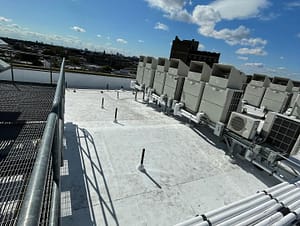
Philadelphia rowhomes almost all have flat roofs. Here is how the systems actually differ, and which one your block was probably built with.
If you own a rowhome in Philadelphia, you own a flat roof. Maybe with a slight pitch toward a drain, but flat enough that water sits on it rather than running off. That single fact changes everything about how your roof fails and what it costs to fix.
The confusing part is that “flat roof” is not one thing. There are five or six systems in common use around here, they look similar from the street, and contractors rarely explain the difference. So here it is plainly.
What Is Probably On Your Roof Now
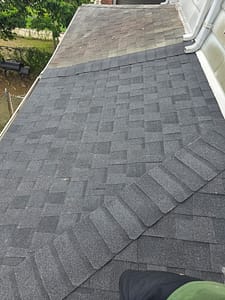
Modified bitumen is the most common thing we find on older Philadelphia rowhomes. It is asphalt-based, applied in multiple layers, and often has a granular or silver-coated surface. It is tough underfoot, which is why it lasted this long on roofs people walk on. It fails at the seams and at the drain.
Built-up roofing — the old tar-and-gravel system — still shows up on houses that have not been touched in decades. If yours has gravel on it, that is what you have, and it is almost certainly past its life.
Roll roofing over roll roofing over roll roofing. This is not a system, it is a history. We open up roofs with four layers of patch jobs regularly. Every layer hides the one below it, which is why nobody has been able to find your leak.
The Single-Ply Membranes
Most modern flat roofs are single-ply: one sheet of membrane, seams welded or bonded, mechanically fastened or fully adhered.
- EPDM is black synthetic rubber. Affordable, proven, lasts decades, and forgiving to install. The workhorse of Philadelphia flat roofs. Downside: black absorbs heat, so it does nothing for your cooling bill.
- TPO is a bright white membrane with heat-welded seams. That white surface reflects sunlight instead of soaking it up, which genuinely helps energy costs on a top-floor unit. Very common on commercial buildings for exactly this reason.
- PVC is similar to TPO but with stronger resistance to grease and standing water. If there is a restaurant kitchen exhaust on your roof, this is the answer.
A membrane roof rarely leaks in the middle. It leaks where things join, meet, or get penetrated.
Where Fiberglass Is Different
Fiberglass roofing — and the Dec-Tec vinyl membrane that often goes with it — is a different category, and it is the one most homeowners have never had explained to them.
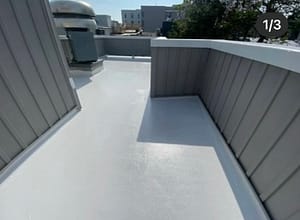
A fiberglass roof is applied wet and cures into one continuous seamless surface. There are no seams to open up, because there are no seams. It bonds directly to the deck and forms around drains, parapets, and pipe penetrations in a single piece.
That matters for two reasons. First, seams are where flat roofs leak, so eliminating them removes the most common failure point. Second, fiberglass and Dec-Tec are walkable. If your flat roof is also your deck — or you want it to be — this is the system that makes that work without a separate waterproofing layer underneath.
The trade-off is cost and craft. It is more expensive per square foot than EPDM, and it is unforgiving of a bad install. Very few local roofers do it. We do, which is honestly why a lot of our rowhome and roof-deck work comes to us.
How Each One Actually Fails
Ask a roofer how a system fails, not just how long it lasts. The answer tells you what you are signing up for.
- Modified bitumen: seams open, surface gets brittle and cracks, blisters form where moisture got trapped underneath.
- EPDM and TPO: seams and flashing details go first. The field of the membrane usually outlives the edges.
- Any flat system: the drain box. It is the lowest, hardest-working point on the roof. Debris clogs it, water ponds, and constant standing water breaks down the seal around it. This is the most common flat roof leak we repair, full stop.
- Fiberglass: rarely fails in the field. When it does, it is a crack from structural movement or an impact — and it is a spot repair, not a system failure.
So Which One Should You Get
Honestly: it depends on your building and how you use the roof, and any roofer who answers that question before looking at your roof is selling, not advising.
- Nobody walks on it, budget matters: EPDM.
- Top-floor unit that bakes in July: TPO.
- The roof is or will be a deck: fiberglass or Dec-Tec.
- Commercial with kitchen exhaust: PVC.
- Four layers of old patches up there: tear-off first, then decide.
Before you get quotes
Ask each contractor what system they are proposing and why. If the answer is a brand name with no reasoning behind it, get another quote. Our inspection is free and comes with photos and a written report, so you can compare what we found against what anyone else is telling you.
Want a straight read on what is on your roof right now and how much life it has left? See our flat roofing page or call 267-977-6452.
Free & No-Obligation
Get a Straight Answer
About Your Roof
Photos, a written report, and an honest read on what it actually needs — from a GAF Certified crew that has been on these roofs for 20+ years.